Fundamentals of Ohm's Law
From the Robotics Reviewer curriculum
Fundamentals of Ohm's Law
TL;DR
Ohm's Law describes the relationship between voltage, current, and resistance in an electrical circuit. It's a fundamental concept in robotics for understanding how power flows and components behave. You'll use it to troubleshoot circuits and pick the right parts for your robot.
1. The Mental Model
Think of electricity like water flowing through a pipe. Voltage is the "pressure" pushing the water, current is the "flow rate," and resistance is how narrow or clogged the pipe is.
2. The Core Material
Ohm's Law is expressed by a simple formula: V = I * R.
- V stands for Voltage, measured in Volts (V). It's the electrical potential difference that pushes current through a circuit.
- I stands for Current, measured in Amperes (A). It's the rate of flow of electric charge.
- R stands for Resistance, measured in Ohms (Ω). It's the opposition to the flow of current.
This formula is incredibly useful because if you know any two of these values, you can always find the third.
2.1 Calculating Voltage

Photo by Tanha Tamanna Syed on Pexels
If you know the current flowing through a component and its resistance, you can find the voltage drop across it.
Voltage (V) = Current (I) * Resistance (R)
2.2 Calculating Current
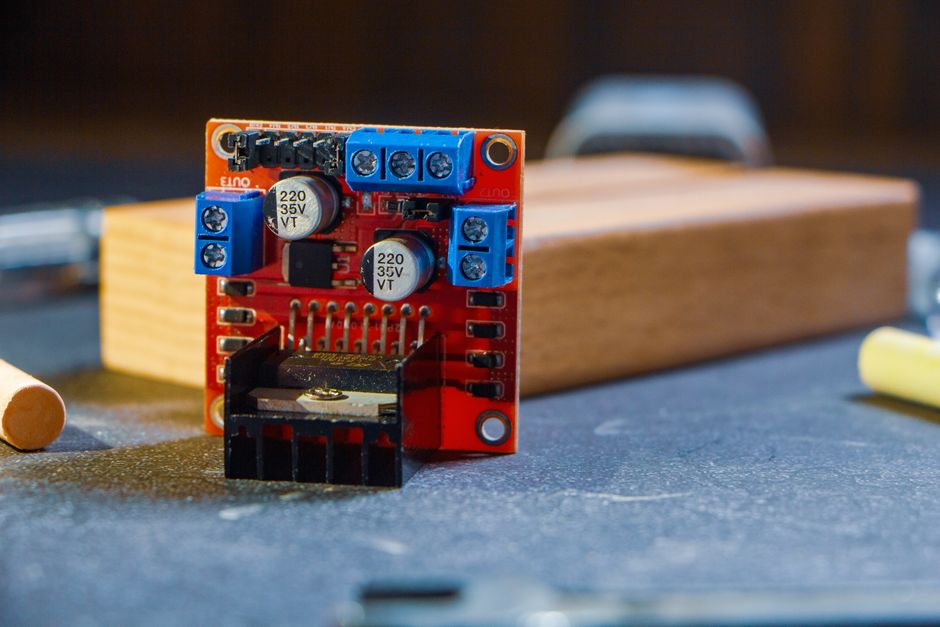
Photo by Tanha Tamanna Syed on Pexels
If you know the voltage applied across a component and its resistance, you can find the current flowing through it.
Current (I) = Voltage (V) / Resistance (R)
2.3 Calculating Resistance

Photo by Mikhail Nilov on Pexels
If you know the voltage applied across a component and the current flowing through it, you can find its resistance. You'd use this if you were trying to identify an unknown resistor, for example.
Resistance (R) = Voltage (V) / Current (I)
It's helpful to visualize these relationships. Here's a diagram showing how these three quantities are interconnected:
graph TD
    A["Voltage (V)"] --> B["Current (I)"]
    B --> C["Resistance (R)"]
    C --> A
    subgraph Ohm's Law Triangle
        V_I("V = I * R")
        I_V("I = V / R")
        R_V("R = V / I")
    end
    style V_I fill:#fff,stroke:#333,stroke-width:2px,color:#000
    style I_V fill:#fff,stroke:#333,stroke-width:2px,color:#000
    style R_V fill:#fff,stroke:#333,stroke-width:2px,color:#000
2.4 Power Considerations

Photo by Pavel Danilyuk on Pexels
While not directly part of Ohm's Law, power is intimately related. Power (P), measured in Watts (W), tells you how much energy is being used or dissipated. The formula for power is P = V * I. You can substitute Ohm's Law into this to get other useful forms:
P = I² * R(if you know current and resistance)P = V² / R(if you know voltage and resistance)
These power formulas are critical for ensuring your components can handle the heat generated by electrical resistance.
3. Worked Example
You're designing a simple robotic arm and need to power a small motor. The motor's datasheet says it has an internal resistance of 10 Ohms and operates optimally at 5 Volts. What current will the motor draw, and how much power will it consume?
-
Identify knowns:
- Voltage (V) = 5 V
- Resistance (R) = 10 Ω
-
Calculate Current (I):
UsingI = V / R
I = 5 V / 10 Ω = 0.5 Amperes -
Calculate Power (P):
UsingP = V * I
P = 5 V * 0.5 A = 2.5 Watts
So, the motor will draw 0.5 Amperes of current and consume 2.5 Watts of power. This information helps you choose the right power supply and ensure your motor driver can handle the current.
4. Key Takeaways
- Ohm's Law (V = I * R) defines the relationship between voltage, current, and resistance.
- Voltage is the "push," current is the "flow," and resistance is the "opposition."
- Knowing any two values allows you to calculate the third using rearranged forms of the formula.
- Power (P = V * I) tells you how much energy is consumed and helps prevent component damage.
- Always use consistent units (Volts, Amperes, Ohms, Watts) in your calculations.
- Ohm's Law is a foundational tool for designing, troubleshooting, and understanding electrical circuits.
Common Mistakes to Avoid:
- Mixing units: Don't use milliamperes (mA) directly with Ohms; always convert to Amperes first.
- Incorrect formula application: Double-check whether you're solving for V, I, or R.
- Ignoring power ratings: Never assume a component can handle unlimited current or voltage without considering its power dissipation limits.
- Forgetting about ground: Voltage is always measured across two points, usually relative to a common ground.
5. Now Try It
Imagine you have a sensor that needs 12V to operate and draws 200mA of current. Your power supply provides 12V. What is the effective resistance of the sensor? How much power does it consume? Work through the calculations step-by-step.
Success looks like: You've correctly calculated both the sensor's resistance in Ohms and its power consumption in Watts, showing your steps and unit conversions.
Frequently asked about Fundamentals of Ohm's Law
Get the full Robotics Reviewer curriculum
Clone the complete plan to your dashboard for unlimited AI-generated notes, practice quizzes, and a personalised revision schedule.
Create Free Account