Foundations of Physics: Mechanics and Energy
From the science curriculum
TL;DR
Mechanics describes how objects move and interact, while energy explains the capacity for movement and change. We'll explore fundamental concepts like force, motion, work, and conservation principles. Understanding these basics helps you predict and explain how the world around you works.
1. The Mental Model
Imagine pushing a toy car (force) and watching it speed up (motion). That push needed energy, and the car now has energy of motion. Physics gives you a way to describe and predict these actions precisely.
2. The Core Material
Physics uses mathematical models to describe the rules governing the universe. In mechanics, we're particularly interested in how forces affect objects and how energy transforms.
Force and Motion
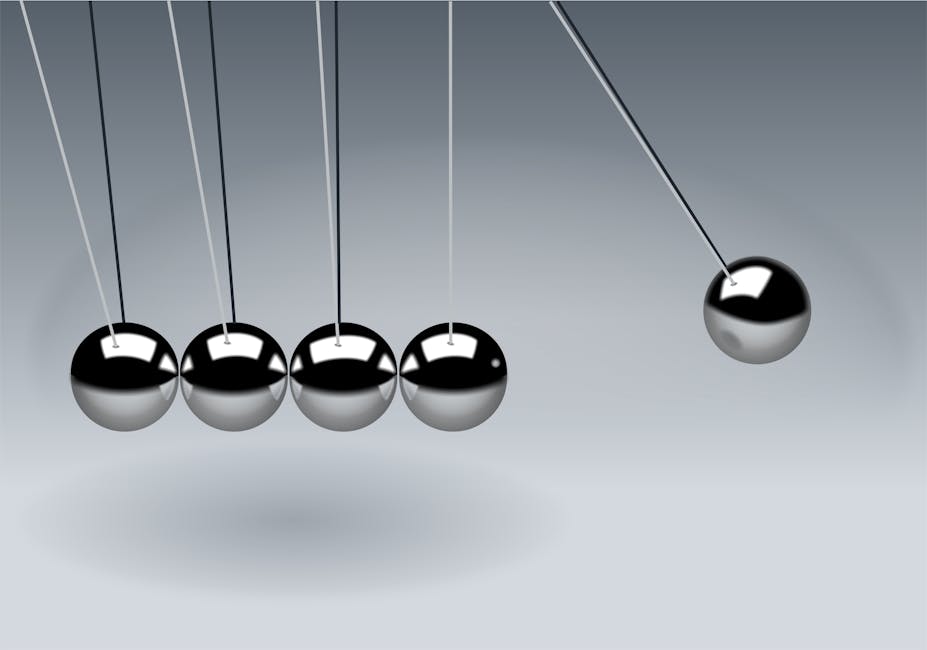
Photo by Pixabay on Pexels
A force is a push or a pull. It's what makes things accelerate (change their speed or direction). Think of kicking a football: your foot applies a force, and the ball moves.
Newton's Three Laws of Motion are the bedrock here:
1. Inertia: An object at rest stays at rest, and an object in motion stays in motion with the same speed and in the same direction, unless acted upon by an unbalanced force. Basically, things are lazy and resist change.
2. F = ma: The acceleration of an object is directly proportional to the net force acting on it and inversely proportional to its mass. This is probably the most famous equation in physics! F is force (measured in Newtons, N), m is mass (measured in kilograms, kg), and a is acceleration (measured in meters per second squared, m/s²). If you push harder on something (increase F), it accelerates more. If it's heavier (increase m), it accelerates less for the same push.
3. Action-Reaction: For every action, there is an equal and opposite reaction. When you push on a wall, the wall pushes back on you with the same force.
Work and Energy

Photo by Utpal Adhikary on Pexels
Work isn't just "doing stuff"; in physics, it has a specific meaning. Work is done when a force causes an object to move a certain distance in the direction of the force. If you push a box across the floor, you're doing work on it. If you push on a wall that doesn't move, you're applying force, but doing no work in the physics sense.
The equation for work is: W = F * d * cos(theta) where W is work (measured in Joules, J), F is the force, d is the distance moved, and theta is the angle between the force and the direction of motion. If the force is in the same direction as motion, cos(theta) is 1, and W = F * d.
Energy is the capacity to do work. An object has energy if it can cause something to move or change. There are many forms of energy, but in mechanics, we often focus on:
- Kinetic Energy (KE): Energy due to motion. If something is moving, it has kinetic energy. The faster or heavier it is, the more KE it has.
KE = 1/2 * m * v^2, wherevis velocity (speed). - Potential Energy (PE): Stored energy due to an object's position or state.
- Gravitational Potential Energy (GPE): Energy an object has because of its height above a reference point.
GPE = m * g * h, wheregis the acceleration due to gravity (approx. 9.8 m/s² on Earth) andhis height. - Elastic Potential Energy: Energy stored in a stretched or compressed spring/rubber band.
- Gravitational Potential Energy (GPE): Energy an object has because of its height above a reference point.
Conservation of Energy

Photo by Riki Risnandar on Pexels
One of the most powerful ideas in physics is the Law of Conservation of Energy: Energy cannot be created or destroyed, only transferred from one form to another or from one object to another. This means the total amount of energy in a closed system (where no energy enters or leaves) stays constant.
For example, a ball thrown upwards slows down (loses KE) but gains height (gains GPE). At its peak, momentarily, it has maximum GPE and minimum KE. As it falls, GPE converts back to KE.
graph TD
    A["Initial State: Object at Rest/Constant Velocity"] --> B{ "Is an unbalanced force applied?" };
    B -- "No" --> A;
    B -- "Yes" --> C["Force (F) causes acceleration (a)"];
    C --> D{"Object moves over distance (d)?"};
    D -- "No" --> C;
    D -- "Yes" --> E["Work (W = F * d) is done"];
    E --> F{"Does object gain speed (v) or height (h)?"};
    F -- "Gains speed" --> G["Kinetic Energy (KE) increases"];
    F -- "Gains height" --> H["Gravitational Potential Energy (GPE) increases"];
    G --> I["Energy Transformation: Chemical/Other -> KE"];
    H --> J["Energy Transformation: Chemical/Other -> GPE"];
    I --> K["Total energy is conserved"];
    J --> K;
    K --> L["New State: Object in motion/at new position"];
3. Worked Example
Let's say you push a 5 kg box across a floor with a constant force of 20 N for a distance of 3 meters. The force is applied horizontally, in the same direction the box moves.
-
Calculate the work done on the box:
W = F * d
W = 20 N * 3 m
W = 60 Joules -
Assuming the box starts from rest and all the work goes into its kinetic energy (no friction):
What would be the final speed of the box?
According to the work-energy theorem, the net work done on an object equals the change in its kinetic energy.
W_net = ΔKE = KE_final - KE_initial
Since it starts from rest,KE_initial = 0. So,W_net = KE_final.
60 J = 1/2 * m * v^2
60 J = 1/2 * 5 kg * v^2
60 = 2.5 * v^2
v^2 = 60 / 2.5
v^2 = 24
v = sqrt(24)
v ≈ 4.9 m/s
So, after being pushed for 3 meters, the 5 kg box would be moving at approximately 4.9 meters per second.
4. Key Takeaways
- Forces are pushes or pulls that cause objects to accelerate (change velocity).
- Newton's Second Law,
F = ma, is central to understanding how forces cause motion. - Work is done only when a force causes displacement in the direction of the force.
- Energy is the capacity to do work, with kinetic energy for motion and potential energy for position.
- The Law of Conservation of Energy states that total energy in a closed system remains constant, only changing forms.
Common mistakes to avoid:
- Confusing force with inertia; inertia is resistance to force, not the force itself.
- Forgetting that work requires movement in the direction of the force. Holding a heavy object stationary does no work.
- Mixing up mass and weight; mass is inherent stuff, weight is the gravitational force on that mass.
- Assuming energy is "used up" rather than transformed when something stops moving (e.g., kinetic energy often converts to heat due to friction).
5. Now Try It
Imagine you're designing a roller coaster. You have a car with a mass of 200 kg at the top of a 25-meter-tall hill, starting from rest. If you ignore friction and air resistance, what will be the car's speed at the bottom of the hill? (Assume g = 9.8 m/s²).
To succeed, you should use the principle of conservation of energy, converting all the initial gravitational potential energy into kinetic energy at the bottom. Your final answer should be a speed in meters per second.
Frequently asked about Foundations of Physics: Mechanics and Energy
Study this next
Get the full science curriculum
Clone the complete plan to your dashboard for unlimited AI-generated notes, practice quizzes, and a personalised revision schedule.
Save this course free