Introduction to Coordinate Planes and Basic Graphing
From the s curriculum
TL;DR
A coordinate plane is like a map for numbers, using two perpendicular lines (axes) to pinpoint locations. These locations, called points, are described by an (x, y) pair. Graphing is simply the act of plotting these points to visualize relationships between numbers.
1. The Mental Model
Imagine a perfectly flat, endless sheet of grid paper. You're given two numbers that tell you exactly where to put a dot. That's essentially what working with a coordinate plane is all about.
2. The Core Material
The coordinate plane is a fundamental tool in math for visualizing relationships between numbers. It's formed by two number lines that cross each other at their zero points.
The Axes

Photo by Mathias Reding on Pexels
- x-axis: This is the horizontal number line. Positive numbers go to the right of zero, negative numbers go to the left.
- y-axis: This is the vertical number line. Positive numbers go up from zero, negative numbers go down.
- Origin: The point where the x-axis and y-axis intersect. Its coordinates are (0, 0).
Coordinates
Every point on the coordinate plane has a unique address called its coordinates. These are written as an ordered pair (x, y).
- The first number (x) tells you how far left or right to move from the origin along the x-axis.
- The second number (y) tells you how far up or down to move from that x-position, along the y-axis.
Plotting Points
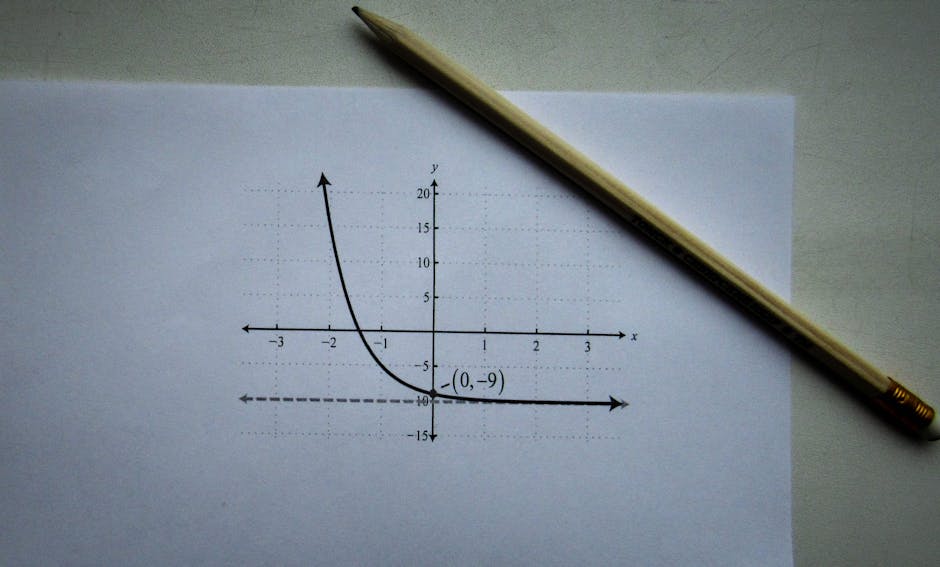
Photo by Sergey Meshkov on Pexels
To plot a point (x, y), you follow these steps:
graph TD
    A["Start at the Origin (0,0)"] --> B["Move horizontally along x-axis"]
    B --> C{Is x positive or negative?}
    C -- "Positive x" --> D["Move x units to the right"]
    C -- "Negative x" --> E["Move |x| units to the left"]
    D --> F["From that horizontal position, move vertically along y-axis"]
    E --> F
    F --> G{Is y positive or negative?}
    G -- "Positive y" --> H["Move y units up"]
    G -- "Negative y" --> I["Move |y| units down"]
    H --> J["Mark the point!"]
    I --> J
Quadrants
The x-axis and y-axis divide the coordinate plane into four regions called quadrants, numbered counter-clockwise using Roman numerals:
- Quadrant I (QI): x-values are positive, y-values are positive (e.g., (2, 3))
- Quadrant II (QII): x-values are negative, y-values are positive (e.g., (-2, 3))
- Quadrant III (QIII): x-values are negative, y-values are negative (e.g., (-2, -3))
- Quadrant IV (QIV): x-values are positive, y-values are negative (e.g., (2, -3))
Points that lie directly on an axis (where either x or y is zero) are not considered to be in any quadrant.
3. Worked Example
Let's plot the following points on a coordinate plane:
1. A (3, 2)
2. B (-4, 1)
3. C (0, -3)
4. D (-2, -3)
Step-by-step:
-
For A (3, 2):
- Start at the origin (0, 0).
- The x-coordinate is 3 (positive), so move 3 units to the right.
- From there, the y-coordinate is 2 (positive), so move 2 units up.
- Mark the point. This point is in Quadrant I.
-
For B (-4, 1):
- Start at the origin (0, 0).
- The x-coordinate is -4 (negative), so move 4 units to the left.
- From there, the y-coordinate is 1 (positive), so move 1 unit up.
- Mark the point. This point is in Quadrant II.
-
For C (0, -3):
- Start at the origin (0, 0).
- The x-coordinate is 0, so don't move left or right from the origin. Stay on the y-axis.
- From there, the y-coordinate is -3 (negative), so move 3 units down.
- Mark the point. This point is on the y-axis, not in any quadrant.
-
For D (-2, -3):
- Start at the origin (0, 0).
- The x-coordinate is -2 (negative), so move 2 units to the left.
- From there, the y-coordinate is -3 (negative), so move 3 units down.
- Mark the point. This point is in Quadrant III.
4. Key Takeaways
- The coordinate plane uses an x-axis (horizontal) and a y-axis (vertical) to locate points.
- An ordered pair (x, y) specifies a point's exact position.
- The origin (0, 0) is the starting point for plotting.
- Move right for positive x, left for negative x.
- Move up for positive y, down for negative y.
- The four quadrants are numbered counter-clockwise from the top-right.
Common mistakes you should avoid:
- Confusing the order: always (x, y), never (y, x).
- Mixing up positive/negative directions: right/up are positive, left/down are negative.
- Starting movements from the origin for both x and y: move x, then move y from that x position.
- Forgetting that points on an axis are not in a quadrant.
5. Now Try It
On a piece of graph paper or by sketching, draw a coordinate plane with labeled axes from -5 to 5. Then, plot the following points: P (4, -1), Q (-3, 0), R (1, 3), S (0, 0), T (-2, -4). Label each point with its letter and identify which quadrant it falls into (or if it's on an axis).
Success looks like: You have distinct points clearly marked and labeled on your graph. Your quadrants are correctly identified for each point.
Frequently asked about Introduction to Coordinate Planes and Basic Graphing
Study this next
Get the full s curriculum
Clone the complete plan to your dashboard for unlimited AI-generated notes, practice quizzes, and a personalised revision schedule.
Save this course free