Fundamentals of Trigonometry and Angles
From the Trigonometry functions curriculum
TL;DR
Trigonometry is all about relationships between angles and side lengths in triangles, especially right triangles. Angles can be measured in degrees or radians, which are just different units for the same thing. Understanding how angles work is key to making sense of trigonometric functions.
1. The Mental Model
Think of angles as measuring how much you've "turned" from a starting line. Sine, cosine, and tangent are simply ratios of side lengths based on how much you've turned in a right triangle.
2. The Core Material
Angles: Degrees vs. Radians
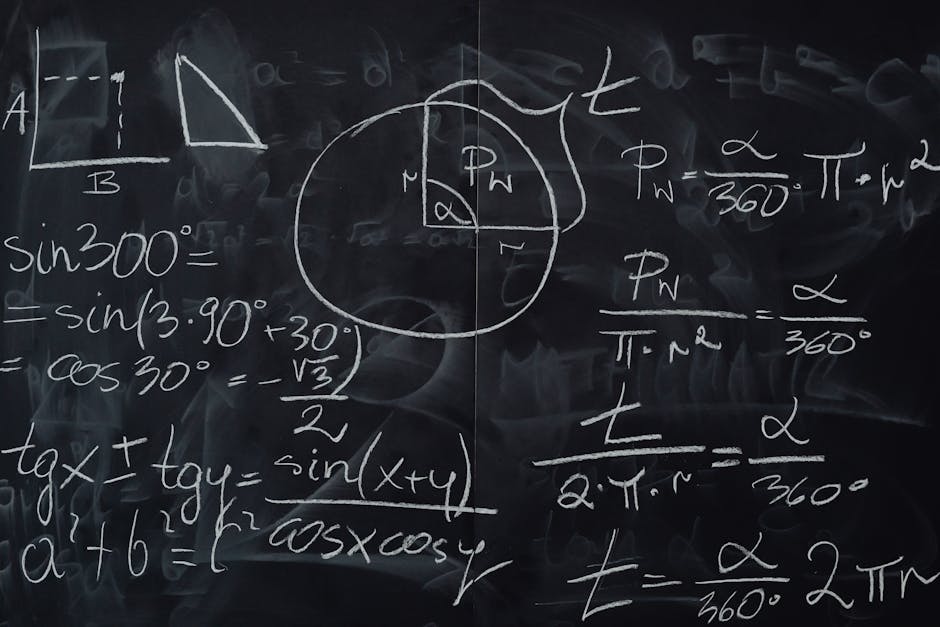
Photo by www.kaboompics.com on Pexels
You're probably used to degrees (360° in a circle). Radians are another way to measure angles, and they're super important in higher math and physics. Imagine a circle with radius 'r'. If you walk along the edge of that circle for exactly 'r' distance, the angle from the center to your start and end points is 1 radian.
- A full circle is $2\pi$ radians.
- So, $360^\circ = 2\pi$ radians.
- This means $180^\circ = \pi$ radians.
To convert:
* Degrees to radians: multiply by $\frac{\pi}{180^\circ}$
* Radians to degrees: multiply by $\frac{180^\circ}{\pi}$
graph TD
    A["Start with Angle"] --> B{{"Unit?"}}
    B -- "Degrees" --> C["Multiply by π/180"]
    B -- "Radians" --> D["Multiply by 180/π"]
    C --> E["Result: Radians"]
    D --> F["Result: Degrees"]
The Standard Position of an Angle

Photo by Dawid Małecki on Pexels
In trigonometry, we often place angles on a coordinate plane.
* The initial side always starts on the positive x-axis.
* The vertex (the point where the two sides meet) is at the origin (0,0).
* The terminal side rotates counter-clockwise for positive angles and clockwise for negative angles.
Right Triangle Trigonometry (SOH CAH TOA)

Photo by www.kaboompics.com on Pexels
For a right-angled triangle, the three basic trig ratios are:
- Sine (sin): Opposite side / Hypotenuse (SOH)
- Cosine (cos): Adjacent side / Hypotenuse (CAH)
- Tangent (tan): Opposite side / Adjacent side (TOA)
Remember these definitions depend on which angle you're looking from. The hypotenuse is always the longest side, opposite the right angle.
3. Worked Example
Let's convert a common angle and find its trig ratios.
Problem: Convert $60^\circ$ to radians. Then, for a right triangle with an angle of $60^\circ$, if the hypotenuse is 10 units, find the lengths of the opposite and adjacent sides.
Solution:
-
Degrees to Radians:
$60^\circ \times \frac{\pi}{180^\circ} = \frac{60\pi}{180} = \frac{\pi}{3}$ radians. -
Finding side lengths:
Let's say angle $\theta = 60^\circ$.
We know:- $\sin(\theta) = \frac{\text{Opposite}}{\text{Hypotenuse}}$
- $\cos(\theta) = \frac{\text{Adjacent}}{\text{Hypotenuse}}$
Given Hypotenuse = 10.
* $\sin(60^\circ) = \frac{\text{Opposite}}{10}$
We know $\sin(60^\circ) = \frac{\sqrt{3}}{2}$.
So, $\frac{\sqrt{3}}{2} = \frac{\text{Opposite}}{10}$
$\text{Opposite} = 10 \times \frac{\sqrt{3}}{2} = 5\sqrt{3}$- $\cos(60^\circ) = \frac{\text{Adjacent}}{10}$
We know $\cos(60^\circ) = \frac{1}{2}$.
So, $\frac{1}{2} = \frac{\text{Adjacent}}{10}$
$\text{Adjacent} = 10 \times \frac{1}{2} = 5$
So, $60^\circ$ is $\frac{\pi}{3}$ radians. In a right triangle with a $60^\circ$ angle and hypotenuse 10, the side opposite the $60^\circ$ angle is $5\sqrt{3}$ and the side adjacent is 5.
4. Key Takeaways
- Angles measure rotation; degrees and radians are two systems for this.
- A full circle is $360^\circ$ or $2\pi$ radians, meaning $180^\circ = \pi$ radians.
- Trigonometric functions (sine, cosine, tangent) describe ratios of sides in a right triangle.
- SOH CAH TOA is a mnemonic to remember $\sin = \text{Opposite}/\text{Hypotenuse}$, $\cos = \text{Adjacent}/\text{Hypotenuse}$, $\tan = \text{Opposite}/\text{Adjacent}$.
- The standard position of an angle starts on the positive x-axis and rotates counter-clockwise for positive values.
- Always be mindful of which angle you're referencing when labeling "opposite" and "adjacent" sides.
Common mistakes to avoid:
* Mixing up degrees and radians in calculations without converting.
* Incorrectly identifying the opposite or adjacent side in a triangle for a given angle.
* Forgetting that "hypotenuse" is always the side opposite the right angle.
* Not understanding that $\sin$, $\cos$, and $\tan$ are ratios, not lengths themselves.
5. Now Try It
Draw a right triangle for angle $30^\circ$. If the side opposite the $30^\circ$ angle is 4 units, calculate the length of the hypotenuse and the adjacent side. Also, convert $30^\circ$ into radians.
Success looks like: You've correctly calculated the hypotenuse and adjacent side lengths using sine and cosine, and you've converted $30^\circ$ to its radian equivalent, which is $\pi/6$.
Frequently asked about Fundamentals of Trigonometry and Angles
Study this next
Get the full Trigonometry functions curriculum
Clone the complete plan to your dashboard for unlimited AI-generated notes, practice quizzes, and a personalised revision schedule.
Save this course free