Functions & Calculus Fundamentals
From the JEE curriculum
Functions & Calculus Fundamentals
TL;DR
Functions describe relationships between variables, assigning a unique output for every input. Calculus extends this by studying how these relationships change, focusing on rates of change (differentiation) and accumulation (integration). Mastering these basics is crucial for almost all higher-level JEE math problems.
1. The Mental Model
Think of a function as a machine: you put something in (input), and it reliably gives you one specific thing out (output). Calculus then helps you understand how fast that machine is running or how much it's produced over time.
2. The Core Material
Functions are the building blocks. You'll deal with their domain (all possible inputs), range (all possible outputs), and various classifications.
What is a Function?

Photo by Ann H on Pexels
A relation $f: A \to B$ is a function if every element in set $A$ (the domain) is mapped to exactly one element in set $B$ (the co-domain).
graph TD
    A["Input Set (Domain)"] --> B{{"Function f(x)"}};
    B --> C["Output Set (Range/Co-domain)"];

    subgraph Function Properties
        C1["Each x in Domain"] --> C2["Maps to EXACTLY ONE y"];
    end

    C3["Vertical Line Test"] --> C1;
    C4["Inverse Function Requires Bijective"] --> C5["One-to-One and Onto"];
Types of Functions:
- One-to-one (Injective): Different inputs always give different outputs. No two $x$'s map to the same $y$. (Horizontal Line Test)
- Onto (Surjective): Every element in the co-domain is an output for at least one input. The range equals the co-domain.
- Bijective: Both one-to-one and onto. These are the ones that have inverse functions.
- Even function: $f(-x) = f(x)$. Symmetric about the y-axis (e.g., $x^2$, $\cos x$).
- Odd function: $f(-x) = -f(x)$. Symmetric about the origin (e.g., $x^3$, $\sin x$).
Calculus: The Study of Change
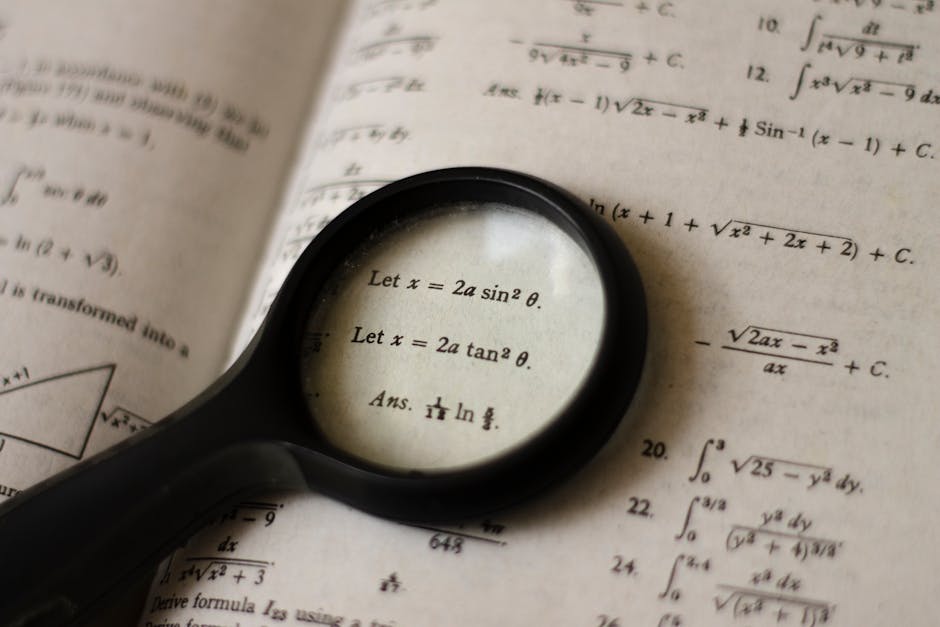
Photo by Nothing Ahead on Pexels
Calculus has two main branches:
2.1. Differential Calculus (Rates of Change)
This is about finding how quickly something is changing. The core concept is the derivative.
The derivative $f'(x)$ of a function $f(x)$ at a point represents the instantaneous rate of change of $f(x)$ with respect to $x$. Geometrically, it's the slope of the tangent line to the function's graph at that point.
Key Idea:
$f'(x) = \lim_{h \to 0} \frac{f(x+h) - f(x)}{h}$
Common derivatives you need to know:
* $\frac{d}{dx}(x^n) = nx^{n-1}$
* $\frac{d}{dx}(\sin x) = \cos x$
* $\frac{d}{dx}(\cos x) = -\sin x$
* $\frac{d}{dx}(e^x) = e^x$
* $\frac{d}{dx}(\ln x) = \frac{1}{x}$
Rules:
* Product Rule: $(uv)' = u'v + uv'$
* Quotient Rule: $(\frac{u}{v})' = \frac{u'v - uv'}{v^2}$
* Chain Rule: $[f(g(x))]' = f'(g(x)) \cdot g'(x)$ (This is super important!)
2.2. Integral Calculus (Accumulation)
This is about finding the total accumulation of a quantity or the area under a curve. The core concept is the integral.
- Indefinite Integral: $\int f(x) dx = F(x) + C$, where $F'(x) = f(x)$. This is the antiderivative. The '+ C' is crucial because the derivative of any constant is zero.
- Definite Integral: $\int_{a}^{b} f(x) dx = F(b) - F(a)$. This calculates the net area between the function and the x-axis from $x=a$ to $x=b$.
Key Idea (Fundamental Theorem of Calculus): Differentiation and integration are inverse operations.
Common integrals you need to know:
* $\int x^n dx = \frac{x^{n+1}}{n+1} + C$ (for $n
eq -1$)
* $\int \frac{1}{x} dx = \ln|x| + C$
* $\int \sin x dx = -\cos x + C$
* $\int \cos x dx = \sin x + C$
* $\int e^x dx = e^x + C$
3. Worked Example
Problem: Find the domain and range of the function $f(x) = \sqrt{x-2} + 3$. Then, find its derivative.
Solution:
-
Domain: For the square root to be defined in real numbers, the expression inside must be non-negative.
$x-2 \ge 0$
$x \ge 2$
So, the domain is $[2, \infty)$. -
Range:
Since $x \ge 2$, then $x-2 \ge 0$.
This means $\sqrt{x-2} \ge 0$.
Adding 3 to both sides: $\sqrt{x-2} + 3 \ge 3$.
So, the range is $[3, \infty)$. -
Derivative:
We need to differentiate $f(x) = \sqrt{x-2} + 3$.
Rewrite $\sqrt{x-2}$ as $(x-2)^{1/2}$.
Using the chain rule for the first term and the power rule:
$\frac{d}{dx}( (x-2)^{1/2} ) = \frac{1}{2}(x-2)^{(1/2)-1} \cdot \frac{d}{dx}(x-2)$
$= \frac{1}{2}(x-2)^{-1/2} \cdot 1$
$= \frac{1}{2\sqrt{x-2}}$
The derivative of the constant '3' is 0.
So, $f'(x) = \frac{1}{2\sqrt{x-2}}$.
4. Key Takeaways
- A function assigns exactly one output for each input; horizontal/vertical line tests help visualize this.
- Calculus is about change: differentiation measures instantaneous rates, integration measures accumulation.
- Domain and range are fundamental for understanding where a function "lives" and what values it can produce.
- Master the basic derivative and integral formulas and the chain rule – they're your primary tools.
- The Fundamental Theorem of Calculus links differentiation and integration as inverse processes.
- Pay close attention to conditions for definitions (e.g., non-negative under square root, non-zero denominator).
- Knowing function types (even, odd, one-to-one, onto) simplifies many problems and helps with symmetry.
Common Mistakes to Avoid:
* Forgetting the $+ C$ in indefinite integrals.
* Improperly applying the chain rule, product rule, or quotient rule.
* Not considering the domain restrictions when finding the range or dealing with derivatives (e.g., $1/x$).
* Confusing one-to-one with onto, or not understanding what makes an inverse function possible.
5. Now Try It
Take any three basic functions (e.g., $f(x) = x^3 - 2$, $g(x) = \sin(2x)$, $h(x) = \frac{1}{x+1}$). For each function, determine its domain and range, then find its first derivative and its indefinite integral.
Success looks like: Correctly identifying all domains and ranges, and accurately performing the differentiation and integration steps using the rules and formulas you've learned.
Frequently asked about Functions & Calculus Fundamentals
Study this next
Get the full JEE curriculum
Clone the complete plan to your dashboard for unlimited AI-generated notes, practice quizzes, and a personalised revision schedule.
Create Free Account