Functions and Limits
From the calculus curriculum
Functions and Limits
TL;DR
Functions describe how one quantity depends on another, letting us model real-world relationships. Limits help us understand a function's behavior as its input gets incredibly close to a specific value, even if the function isn't defined at that exact point. Together, they form the bedrock of calculus, allowing us to study change and continuity.
1. The Mental Model
Think of a function as a machine: you put something in (an input), and it consistently spits something out (an output) according to a rule. A limit is like trying to predict exactly where a moving object will be when it reaches a certain point, even if it briefly disappears or teleports at that point.
2. The Core Material
What's a Function?

Photo by Efrem Efre on Pexels
A function assigns exactly one output for every input. If you put in 'x', you always get the same 'y' out. We write it as f(x). For example, f(x) = x + 2 means if you input x=3, you output y=5. You can't put in x=3 and sometimes get 5 and sometimes 7.
Understanding Limits

Photo by Pranjall Kumar on Pexels
A limit tells us what value a function is approaching as its input approaches some number. It's about the function's behavior near a point, not necessarily at the point itself. We write this as:
lim (x→a) f(x) = L
This reads: "The limit of f(x) as x approaches a is L."
Why do we need limits?

Photo by Markus Winkler on Pexels
Limits are crucial for situations where a function might be undefined at a specific point, but we still want to understand its behavior around that point.
For example, f(x) = (x^2 - 4) / (x - 2). If you try to plug in x=2, you get 0/0, which is undefined. However, if you factor the numerator (x-2)(x+2), you can simplify f(x) = x+2 (as long as x ≠ 2).
As x gets closer and closer to 2, f(x) gets closer and closer to 2+2=4. So, lim (x→2) f(x) = 4. The limit exists even though the function itself doesn't have a value at x=2.
graph TD
    A["Consider a Point (x=a)"] --> B{"Is f(a) Defined?"}
    B -- "Yes" --> C["f(a) exists"]
    C --> D{"Is f(a) = lim (x→a) f(x)?"}
    D -- "Yes" --> E["Function is Continuous at 'a'"]
    D -- "No" --> F["Function has a 'Jump' or 'Hole' at 'a'"]
    B -- "No" --> G["f(a) doesn't exist"]
    G --> H{"Does lim (x→a) f(x) exist?"}
    H -- "Yes" --> I["Function has a 'Hole' at 'a'"]
    H -- "No" --> J["Function has a 'Jump' or Vertical Asymptote at 'a'"]
One-Sided Limits
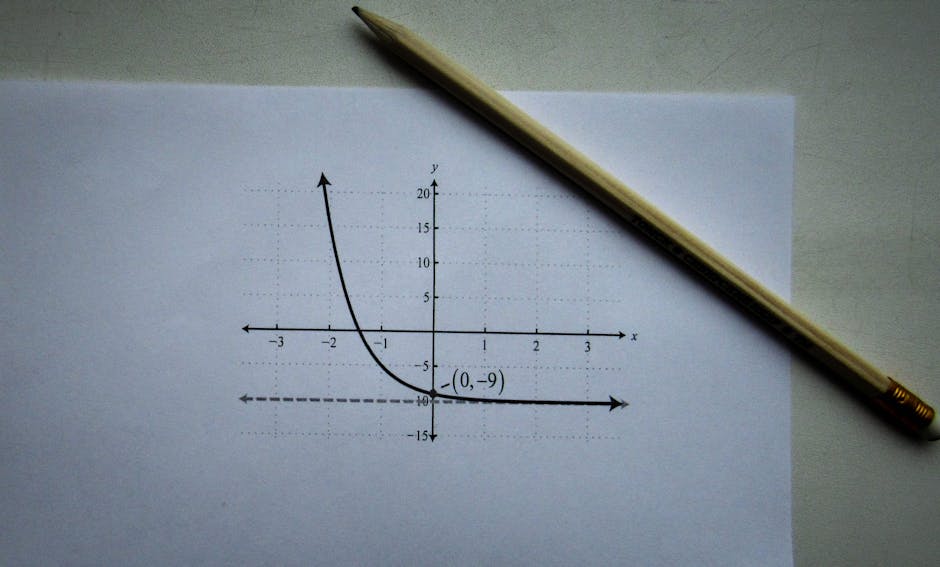
Photo by Sergey Meshkov on Pexels
Sometimes, a function approaches different values depending on whether x approaches a from the left (smaller values) or from the right (larger values).
- Left-hand limit: lim (x→a⁻) f(x)
- Right-hand limit: lim (x→a⁺) f(x)
For a general limit lim (x→a) f(x) to exist, the left-hand limit must equal the right-hand limit.
Properties of Limits
Limits behave nicely with basic arithmetic operations:
- lim (x→a) [f(x) + g(x)] = lim (x→a) f(x) + lim (x→a) g(x)
- lim (x→a) [c * f(x)] = c * lim (x→a) f(x) (where c is a constant)
- Similar rules apply for subtraction, multiplication, and division (as long as you don't divide by zero).
How to calculate limits (briefly)
- Direct Substitution: If
f(x)is a "nice" function (polynomials, most basic trig functions), oftenlim (x→a) f(x) = f(a). - Algebraic Simplification: If direct substitution gives
0/0or∞/∞, try factoring, canceling terms, or rationalizing to simplify the expression before plugging ina. - Graphing: Sometimes looking at the graph helps you see what value the function approaches.
3. Worked Example
Let's find lim (x→3) (x^2 - 9) / (x - 3).
-
Try direct substitution: Plugging in
x=3gives(3^2 - 9) / (3 - 3) = (9 - 9) / 0 = 0/0. This means the limit isn't immediately obvious and we need to simplify. -
Factor the numerator: The numerator
x^2 - 9is a difference of squares, so it factors to(x - 3)(x + 3). -
Rewrite the expression: Now we have
lim (x→3) [(x - 3)(x + 3)] / (x - 3). -
Cancel common terms: Since
xis approaching3but is not exactly equal to3,x - 3is not zero, so we can cancel(x - 3)from the numerator and denominator.
This leaveslim (x→3) (x + 3). -
Apply direct substitution again: Now, plugging in
x=3into(x + 3)gives3 + 3 = 6.
So, lim (x→3) (x^2 - 9) / (x - 3) = 6. Even though the original function was undefined at x=3, its limit as x approaches 3 is 6.
4. Key Takeaways
- A function assigns exactly one output for each input, following a predictable rule.
- The limit of a function describes its behavior as its input gets arbitrarily close to a specific value.
- Limits are essential for understanding functions that have "holes" or are undefined at specific points.
- For a limit to exist, the function must approach the same value from both the left and the right sides.
- You can often find limits using direct substitution, simplification, or by inspecting a graph.
- Common Mistakes:
- Confusing
f(a)(the function's value ata) withlim (x→a) f(x)(the value it approaches neara). They're not always the same! - Assuming a limit doesn't exist just because direct substitution results in
0/0. This often means algebraic simplification is needed. - Ignoring one-sided limits when dealing with piecewise functions or functions with jumps.
- Confusing
5. Now Try It
Consider the piecewise function f(x) defined as:
f(x) = x + 1 for x < 2
f(x) = 5 for x = 2
f(x) = x^2 - 1 for x > 2
Task: Find the left-hand limit lim (x→2⁻) f(x), the right-hand limit lim (x→2⁺) f(x), and f(2). Then, determine if lim (x→2) f(x) exists, and explain why or why not.
What success looks like: You'll have three numerical answers, a clear yes/no, and a concise explanation based on the relationship between the one-sided limits.
Frequently asked about Functions and Limits
Study this next
Get the full calculus curriculum
Clone the complete plan to your dashboard for unlimited AI-generated notes, practice quizzes, and a personalised revision schedule.
Create Free Account