Fundamentals of Behavior (Gedrag)
From the biologie curriculum
Gedrag: Fundamentals of Behavior
TL;DR
Gedrag is how an organism responds to stimuli from its environment or internal states. It's often categorized as innate (inherited) or learned (developed through experience), but these sometimes blend. Understanding behavior helps us make sense of why animals and people do what they do.
1. The Mental Model
Think of behavior as an animal's "action" or "reaction." It's triggered by something – a sight, a sound, a feeling – and results in a specific response. It's how an organism interacts with its world to survive and reproduce.
2. The Core Material
Behavior, or gedrag, in biology refers to the entire range of observable actions and reactions of an organism in response to internal or external stimuli. It's a complex field, but we can simplify it by looking at its main categories and how it develops.
Innate Behavior (Instinct)

Photo by Casey Ulesich on Pexels
These behaviors are genetically programmed and don't require learning or prior experience. They're often present from birth and are crucial for survival. You can think of them as "hard-wired."
- Reflexes: Simple, involuntary, rapid responses to a stimulus (e.g., blinking, knee jerk).
- Fixed Action Patterns (FAPs): More complex sequences of behaviors that are unlearned and once started, usually run to completion, even if the stimulus is removed (e.g., a goose rolling an egg back into its nest, even if the egg is removed mid-roll).
- Taxes: Directed movements toward or away from a stimulus (e.g., moths flying towards light - phototaxis; paramecium moving away from a harmful chemical - chemotaxis).
Learned Behavior
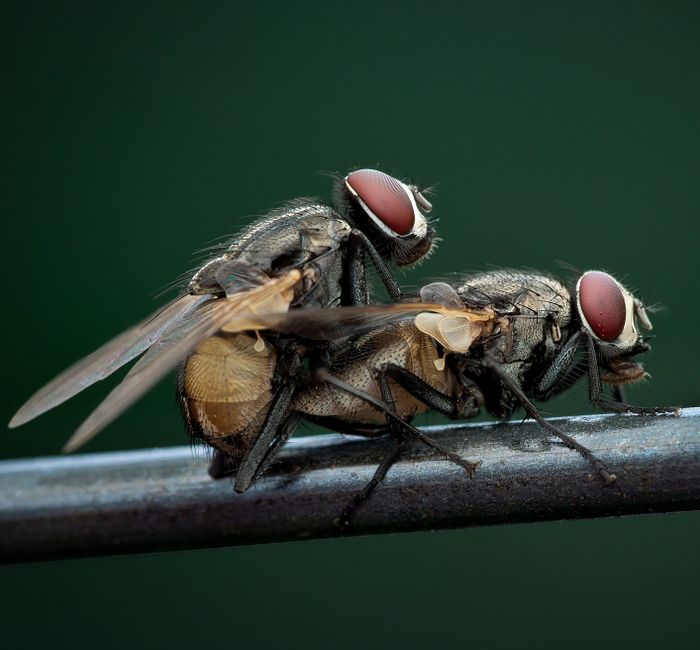
Photo by Macro Photography on Pexels
These behaviors develop or change as a result of experience. They allow organisms to adapt to changing environmental conditions and are often more flexible than innate behaviors.
- Habituation: A decrease in response to a repeated stimulus that proves to be harmless or irrelevant (e.g., birds initially alarm at a scarecrow but ignore it over time).
- Imprinting: A rapid and irreversible type of learning that occurs during a critical period in an animal's early life, usually involving recognition of a parent or mate (e.g., ducklings following the first moving object they see).
- Classical Conditioning: Learning to associate an unconditioned stimulus (UCS) that naturally produces a response with a new, conditioned stimulus (CS). Think Pavlov's dogs associating a bell with food.
- Operant Conditioning: Learning through rewards and punishments. An animal learns to associate its own behavior with a consequence (e.g., a rat pressing a lever to get food). Also known as trial-and-error learning.
- Observational Learning: Learning by watching and imitating others (e.g., young chimpanzees learning to use tools by observing adults).
Nature vs. Nurture

Photo by Nothing Ahead on Pexels
The debate over whether behavior is primarily innate ("nature") or learned ("nurture") is a classic one. In reality, most behaviors are a combination of both. Genes provide the potential or predisposition, while the environment shapes how that potential is expressed. For example, a bird might be genetically programmed to sing, but the specific song it sings (dialect) is often learned from other birds in its environment.
graph TD
    A["Stimulus (Internal/External)"] --> B{"Organism"}
    B --> C{{"Is behavior Innate?"}}
    C -- "Yes" --> D["Innate Response (e.g., Reflex, FAP, Taxis)"]
    C -- "No" --> E{{"Is behavior Learned?"}}
    E -- "Yes" --> F["Learned Response (e.g., Habituation, Conditioning, Imprinting)"]
    E -- "No" --> G["Complex Interaction / No Direct Response"]
    D --> H["Outcome (e.g., Survival, Reproduction)"]
    F --> H
    G --> H
3. Worked Example
Let's consider a baby bird, like a thrush, learning to sing its species' song.
- Innate component: The thrush has an innate predisposition to sing. Its brain is wired to recognize and produce sounds within a certain vocal range typical for its species. If raised in isolation, it will produce a rudimentary, simple version of its song. This foundational ability is innate.
- Learned component: To develop a fully complex and species-specific song, the young thrush needs to hear the songs of adult thrushes during a critical learning period. It memorizes these songs (imprinting/observational learning) and then practices them, refining its own vocalizations to match the songs it heard. Eventually, it produces a complete song that its parents and other thrushes recognize, allowing it to attract mates and defend territory.
So, the ability to sing is innate, but the specific complex song is learned by observing and imitating.
4. Key Takeaways
- Behavior is any observable action or reaction an organism performs in response to stimuli.
- Innate behaviors are inherited, "hard-wired" responses like reflexes and fixed action patterns.
- Learned behaviors develop through experience, allowing for adaptation to new situations.
- Examples of learned behaviors include habituation, classical conditioning, operant conditioning, and imprinting.
- Most behaviors are a blend of innate predispositions and environmental learning, often called nature vs. nurture.
- Understanding an animal's behavior helps explain how it survives and reproduces in its environment.
Common Mistakes to Avoid:
* Don't confuse reflexes with fixed action patterns; reflexes are simpler and faster.
* Don't assume all behavior is learned; many crucial actions are innate.
* Avoid thinking of nature and nurture as completely separate; they heavily interact.
* Don't simply describe behavior; try to think about why an organism exhibits that behavior (its adaptive value).
5. Now Try It
Think about a common pet, like a dog. List at least two behaviors your dog exhibits that you think are primarily innate, and two that are primarily learned. For each learned behavior, briefly explain how you think it was learned (e.g., through reward, observation, habituation).
Successful completion looks like: You've identified specific, distinct behaviors for each category and provided a plausible, brief explanation for the learned ones.
Frequently asked about Fundamentals of Behavior (Gedrag)
Study this next
Get the full biologie curriculum
Clone the complete plan to your dashboard for unlimited AI-generated notes, practice quizzes, and a personalised revision schedule.
Create Free Account