Functions in Pre-Calculus
From the pre-calculus curriculum
TL;DR
Functions are special relationships where each input has exactly one output, helping us model all sorts of scenarios consistently. You can spot them by checking that no input value repeats with different outputs. Understanding functions is foundational for nearly all advanced math you'll encounter.
1. The Mental Model
Think of a function like a vending machine: you put in a specific button (input), and you reliably get one specific item (output) every single time. It never gives you two different items for the same button press.
2. The Core Material
In pre-calculus, a function is a rule that assigns each input exactly one output. We often use the notation $f(x)$ to represent a function, where $x$ is the input and $f(x)$ is the output. This read as "f of x".
Here's what that means:
Identifying Functions

Photo by Shubham Dhage on Pexels
You can identify a function in a few ways:
- From a set of ordered pairs: If you have a list of $(x, y)$ pairs, it's a function if no two pairs have the same first element ($x$) but different second elements ($y$).
- Example: $\{(1, 2), (2, 4), (3, 6)\}$ is a function.
- Example: $\{(1, 2), (1, 5), (2, 4)\}$ is NOT a function because the input
1gives two different outputs (2and5).
- From an equation: If you can solve the equation for $y$ and each $x$ value gives only one $y$ value, it's a function.
- Example: $y = 2x + 1$ is a function. For any $x$ you pick, there's only one $y$.
- Example: $x^2 + y^2 = 9$ is NOT a function. If $x=0$, then $y^2=9$, so $y=3$ or $y=-3$. One input gives two outputs.
- From a graph (Vertical Line Test): If you can draw any vertical line through the graph and it intersects the graph at most once, then it's a function. If any vertical line hits the graph more than once, it's not a function.
graph TD
    A["Begin"] --> B{"Is it a relationship?"};
    B -- "No" --> C["Not a function (or even a relation)"];
    B -- "Yes" --> D{"Does EACH 'Input Value' (x) have ONLY ONE 'Output Value' (y)?"};
    D -- "No (e.g., (1,2) and (1,5))" --> C;
    D -- "Yes" --> E["It IS a Function"];
    E --> F["End"];
Domain and Range
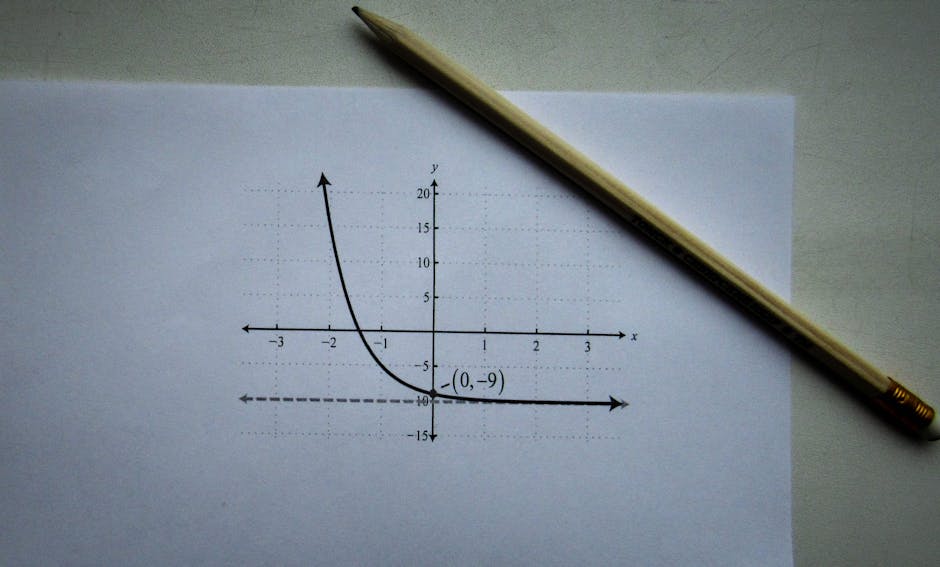
Photo by Sergey Meshkov on Pexels
- Domain: This is the set of all possible input values (x values) for which the function is defined.
- For most functions you'll see early on, the domain is all real numbers ($\mathbb{R}$) unless you have division by zero or the square root of a negative number.
- Example: For $f(x) = 1/x$, $x$ cannot be 0, so the domain is $(-\infty, 0) \cup (0, \infty)$.
- Example: For $f(x) = \sqrt{x}$, $x$ cannot be negative, so the domain is $[0, \infty)$.
- Range: This is the set of all possible output values (y values) that the function can produce. This can sometimes be harder to determine directly from the equation and often involves looking at the graph or understanding the function's behavior.
Evaluating Functions
Photo by Shubham Dhage on Pexels
Evaluating a function means finding the output for a given input. You simply substitute the input value for $x$ in the function's rule.
Example: If $f(x) = 3x - 5$:
* To find $f(2)$, substitute $2$ for $x$: $f(2) = 3(2) - 5 = 6 - 5 = 1$.
* To find $f(a+1)$, substitute $a+1$ for $x$: $f(a+1) = 3(a+1) - 5 = 3a + 3 - 5 = 3a - 2$.
3. Worked Example
Let's consider the function $g(x) = x^2 - 4x + 3$.
- Is it a function? Yes, because for every input $x$, squaring it, multiplying $x$ by 4, and adding 3 will always result in exactly one output value $g(x)$.
- Find the domain: Since there's no division by zero or square roots of negatives, the domain is all real numbers, or $(-\infty, \infty)$.
- Evaluate $g(-1)$:
Substitute $-1$ for $x$:
$g(-1) = (-1)^2 - 4(-1) + 3$
$g(-1) = 1 + 4 + 3$
$g(-1) = 8$ - Evaluate $g(2p)$:
Substitute $2p$ for $x$:
$g(2p) = (2p)^2 - 4(2p) + 3$
$g(2p) = 4p^2 - 8p + 3$
4. Key Takeaways
- A function is a special relationship where each input has exactly one output.
- You can use the Vertical Line Test to quickly determine if a graph represents a function.
- The domain is all valid inputs; the range is all possible outputs.
- Evaluating a function means plugging an input value into the function's rule to find its corresponding output.
- Function notation like $f(x)$ is just a way to name the function and its output for a given $x$.
Common Mistakes to Avoid

Photo by KATRIN BOLOVTSOVA on Pexels
- Confusing input and output: Remember $x$ is typically input, $f(x)$ (or $y$) is output.
- Violating the "unique output" rule: Don't assume something is a function if an input leads to multiple outputs (like $x^2 + y^2 = r^2$).
- Incorrectly determining domain: Always check for values that would cause division by zero or square roots of negative numbers.
- Algebraic errors when evaluating: Be careful with order of operations and signs when substituting values into the function's rule.
5. Now Try It
Consider the function $h(t) = \frac{t+5}{t-2}$.
1. Determine if this is a function and explain why.
2. Find the domain of $h(t)$.
3. Evaluate $h(4)$ and $h(-5)$.
Success looks like: you've correctly identified it as a function, stated its domain using interval notation, and provided the correct numeric outputs for both evaluations.
Frequently asked about Functions in Pre-Calculus
Study this next
Get the full pre-calculus curriculum
Clone the complete plan to your dashboard for unlimited AI-generated notes, practice quizzes, and a personalised revision schedule.
Save this course free