Introduction to Matter and Mixtures
From the Exploring mixtures and their separation curriculum
TL;DR
Everything around you, from the air you breathe to the chair you're sitting on, is matter, which exists as pure substances or mixtures. Pure substances, like elements and compounds, have a consistent makeup, while mixtures combine substances without changing them chemically. We'll explore how to tell matter apart and how to classify different types of mixtures.
1. The Mental Model
Think of matter as all the 'stuff' in the universe. This 'stuff' can be perfectly uniform, like pure gold, or it can be a combination of different 'stuffs' thrown together, like muddy water. Our goal is to understand these different forms.
2. The Core Material
Matter is anything that has mass and takes up space (volume). You probably already have an intuitive grasp of this! We classify matter into two main categories: pure substances and mixtures.
Pure Substances
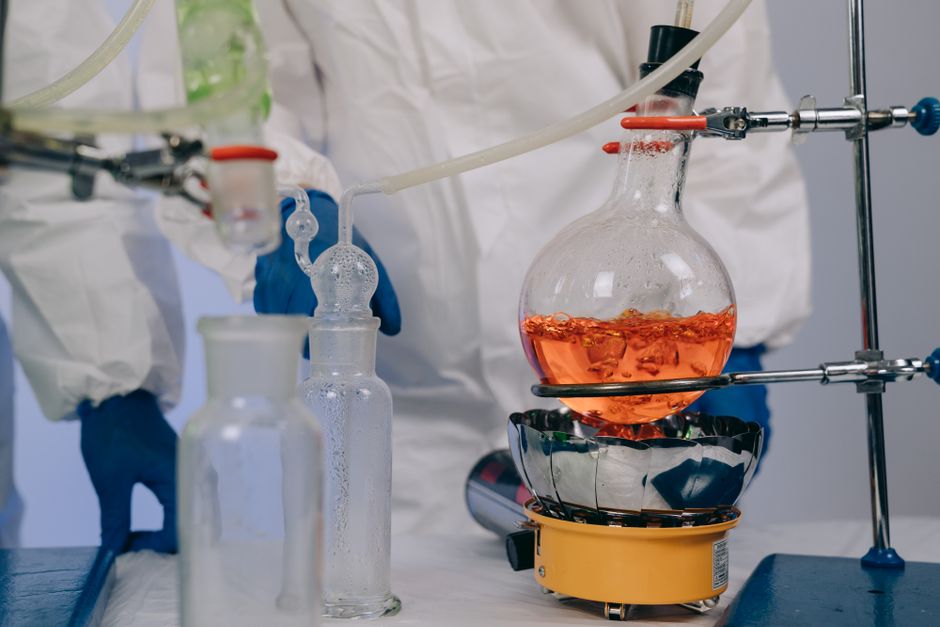
Photo by Mikhail Nilov on Pexels
A pure substance has a definite and constant composition, meaning its properties are the same throughout. You can't separate a pure substance into simpler components by physical means.
- Elements: These are the simplest pure substances. They can't be broken down into anything simpler by chemical reactions. Think of gold (Au), oxygen (O), or carbon (C). Each element is made up of only one type of atom.
- Compounds: These are pure substances formed when two or more different elements chemically combine in a fixed ratio. Water (H₂O) is a compound because it always has two hydrogen atoms for every one oxygen atom, and its properties are very different from hydrogen gas and oxygen gas individually. Salt (NaCl) is another example. Compounds can only be separated into their elements by chemical reactions.
Mixtures
A mixture is a physical combination of two or more substances where each substance retains its individual chemical properties. Unlike compounds, the components of a mixture aren't chemically bonded and can often be separated by physical means.
- Homogeneous Mixtures (Solutions): These mixtures have a uniform composition and appearance throughout. You can't see the different components with the naked eye. Think of sugar dissolved in water, air (a mixture of gases like nitrogen, oxygen, etc.), or brass (an alloy of copper and zinc). Every part of a homogeneous mixture looks and behaves the same.
- Heterogeneous Mixtures: These mixtures do not have a uniform composition; you can see the different components or at least recognize that it's not uniform. Examples include sand and water, oil and vinegar salad dressing, or a bowl of mixed nuts. The properties vary from one part of the mixture to another.
Here's a diagram to help visualize the classification of matter:
graph TD
    A["Matter"] --> B["Pure Substance"]
    A --> C["Mixture"]

    B --> D["Element"]
    B --> E["Compound"]

    C --> F["Homogeneous Mixture (Solution)"]
    C --> G["Heterogeneous Mixture"]

    D_examples["(Gold, Oxygen)"]
    E_examples["(Water, Salt)"]
    F_examples["(Salt water, Air)"]
    G_examples["(Sand & water, Salad dressing)"]

    D --- D_examples
    E --- E_examples
    F --- F_examples
    G --- G_examples
3. Worked Example
Let's classify a few everyday items:
- Tap Water: When you look at tap water, you can't see individual components. It looks uniform. However, it usually contains dissolved minerals, salts, and possibly chlorine. It's not just H₂O.
- Classification: It's a homogeneous mixture (specifically, a solution). If it were pure H₂O, it would be a compound.
- Pizza: A pizza clearly has separate components: dough, sauce, cheese, toppings. You can see and pick out the different parts.
- Classification: This is a heterogeneous mixture.
- Aluminum Foil: Aluminum foil is made entirely of the element aluminum. It's uniform throughout and can't be broken down further by chemical means.
- Classification: This is a pure substance, specifically an element.
4. Key Takeaways
- Matter is anything that has mass and takes up space.
- Pure substances have a consistent composition and properties, like elements or compounds.
- Elements are the simplest pure substances, made of only one type of atom.
- Compounds are pure substances formed by chemically combining two or more elements in a fixed ratio.
- Mixtures are physical combinations of substances where each retains its own properties.
- Homogeneous mixtures (solutions) have a uniform composition; you can't see the different parts.
- Heterogeneous mixtures have non-uniform compositions; you can often see distinct components.
Common Mistakes to Avoid:
- Don't confuse compounds with mixtures; compounds are chemically bonded, mixtures are physically combined.
- Forgetting that air is a (homogeneous) mixture, not a single substance.
- Assuming pure water as you drink it is a compound; it's often a solution (homogeneous mixture) due to dissolved impurities.
- Thinking that if you can filter something out, it must be a heterogeneous mixture (e.g., very finely dispersed particles in some solutions might be filterable, but it's still about the uniformity of appearance).
5. Now Try It
Go around your home and pick five different items. For each item, decide whether it's a pure substance (and if so, an element or a compound) or a mixture (and if so, homogeneous or heterogeneous).
What success looks like: You can correctly classify objects like sugar, granite, steel, pure oxygen tank, and milk, providing a brief reason for your classification.
Frequently asked about Introduction to Matter and Mixtures
Study this next
Get the full Exploring mixtures and their separation curriculum
Clone the complete plan to your dashboard for unlimited AI-generated notes, practice quizzes, and a personalised revision schedule.
Save this course free