Algebraic Foundations
From the math curriculum
TL;DR
Algebra is about using letters (variables) to represent unknown numbers and relationships, allowing you to solve for those unknowns. It helps you generalize patterns and build equations to model real-world situations. Mastering basic operations with these variables is crucial for almost all higher math.
1. The Mental Model
Think of algebra as a language for describing relationships between quantities when some of them are unknown or can change. You're essentially playing detective, using clues to figure out what those hidden numbers are.
2. The Core Material
Algebra extends arithmetic by introducing variables, which are usually letters like $x$, $y$, or $a$, that stand in for numbers we don't know yet or numbers that can change.
Understanding Variables and Expressions
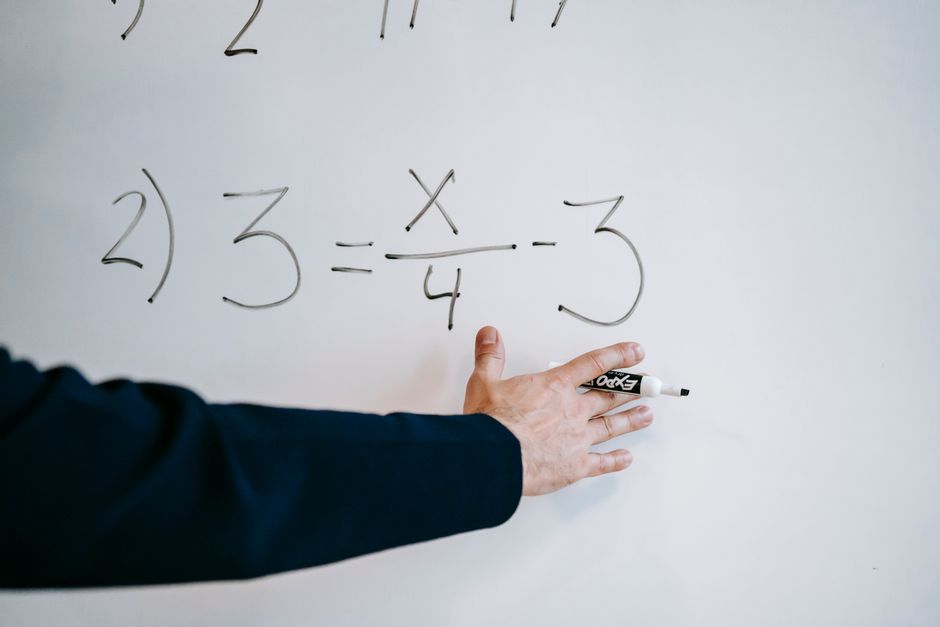
Photo by Vanessa Garcia on Pexels
An expression is a combination of variables, numbers, and operations (like addition, subtraction, multiplication, division). It doesn't have an equals sign.
- Example:
3x + 5(Here,xis the variable)
Equations and Solving Them
Photo by Monstera Production on Pexels
An equation is a statement that two expressions are equal. The goal is often to find the value(s) of the variable(s) that make the equation true. To do this, you want to "isolate" the variable on one side of the equation.
The core principle for solving equations is: "Whatever you do to one side of the equation, you must do to the other side to keep it balanced."
Let's break down the process of solving a simple linear equation:
graph TD
    A["Start with the equation"] --> B["Identify the variable (e.g., x)"]
    B --> C["Undo addition/subtraction near the variable"]
    C --> D["Undo multiplication/division near the variable"]
    D --> E["Variable is isolated! "]
    E --> F["Check your answer by plugging it back in"]
Basic Operations with Variables

Photo by www.kaboompics.com on Pexels
You can add, subtract, multiply, and divide variables just like numbers, but you need to be careful with like terms.
-
Adding/Subtracting: You can only add or subtract terms that have the exact same variable part and exponent.
3x + 5x = 8x(Like terms)3x + 5y(Not like terms, so you can't combine them further)7x^2 - 2x^2 = 5x^2(Like terms)7x^2 - 2x(Not like terms)
-
Multiplying: You can multiply any terms. Multiply the numbers, and multiply the variables (add their exponents if they're the same variable).
3 * x = 3x2x * 4y = 8xyx * x = x^2(2x) * (3x) = 6x^2
-
Dividing: Similar to multiplication, terms don't need to be "like terms" to divide, but you're often looking to simplify fractions.
6x / 2 = 3x10xy / 5y = 2x
Distributive Property

Photo by www.kaboompics.com on Pexels
This is super important: a * (b + c) = a*b + a*c. You multiply the term outside the parentheses by every term inside.
- Example:
2 * (x + 3) = 2x + 6
3. Worked Example
Let's solve for $x$: 3x - 7 = 11
- Identify the variable: It's
x. - Undo addition/subtraction: We have
-7with the3x. To undo this, we add7to both sides.
3x - 7 + 7 = 11 + 7
3x = 18 - Undo multiplication/division: We have
3multiplyingx. To undo this, we divide both sides by3.
3x / 3 = 18 / 3
x = 6 - Check your answer: Plug
x = 6back into the original equation.
3 * (6) - 7 = 11
18 - 7 = 11
11 = 11(It works!)
4. Key Takeaways
- Variables are placeholders for unknown numbers, making algebra a way to solve numerical puzzles.
- The fundamental rule for equations is to apply the same operation to both sides to maintain balance.
- You can only add or subtract "like terms" – those with identical variable parts and exponents.
- When multiplying terms with variables, multiply the numbers and add the exponents of identical variables.
- The distributive property is crucial for expanding expressions like
a(b+c)intoab + ac. - Always check your solution by plugging the value back into the original equation.
Common Mistakes to Avoid:
- Not performing the same operation on both sides of an equation.
- Trying to add or subtract unlike terms (e.g., 3x + 2y cannot be 5xy).
- Forgetting to distribute a number to all terms inside parentheses (e.g., 2(x+3) becoming 2x+3 instead of 2x+6).
- Mixing up multiplication (x * x = x^2) with addition (x + x = 2x).
5. Now Try It
Solve the equation: 5(y + 2) - 3 = 2y + 19 for the variable y. What success looks like: you'll arrive at a single numerical value for y that makes the equation true when you substitute it back. You should show each step clearly.
Frequently asked about Algebraic Foundations
Study this next
Get the full math curriculum
Clone the complete plan to your dashboard for unlimited AI-generated notes, practice quizzes, and a personalised revision schedule.
Save this course free