Kinematics: Describing Motion
From the fisicaa gay curriculum
TL;DR
Kinematics is all about describing how things move without worrying about why they move. You'll learn about position, velocity, and acceleration to precisely track an object's path. We'll mainly focus on motion in a straight line, which is simpler but builds the foundation for more complex scenarios.
1. The Mental Model
Think of kinematics like giving directions: you're telling someone where something is, how fast it's going, and if it's speeding up or slowing down. You're not concerned with who's driving or what kind of engine it has, just the motion itself.
2. The Core Material
Kinematics is the foundational part of mechanics that deals with the description of motion without considering the forces that cause the motion. We use a few key quantities to describe motion precisely.
Position, Displacement, and Distance

Photo by Pixabay on Pexels
- Position is where an object is located relative to a reference point (origin). It's a vector, meaning it has both magnitude (how far) and direction. We often use
$x$for horizontal position and$y$for vertical. - Distance is the total path length traveled. It's a scalar, so it only has magnitude.
- Displacement is the change in an object's position. It's a vector, pointing from the initial position to the final position.
- Displacement ($\Delta x$) = Final position ($x_f$) - Initial position ($x_i$)
Speed and Velocity
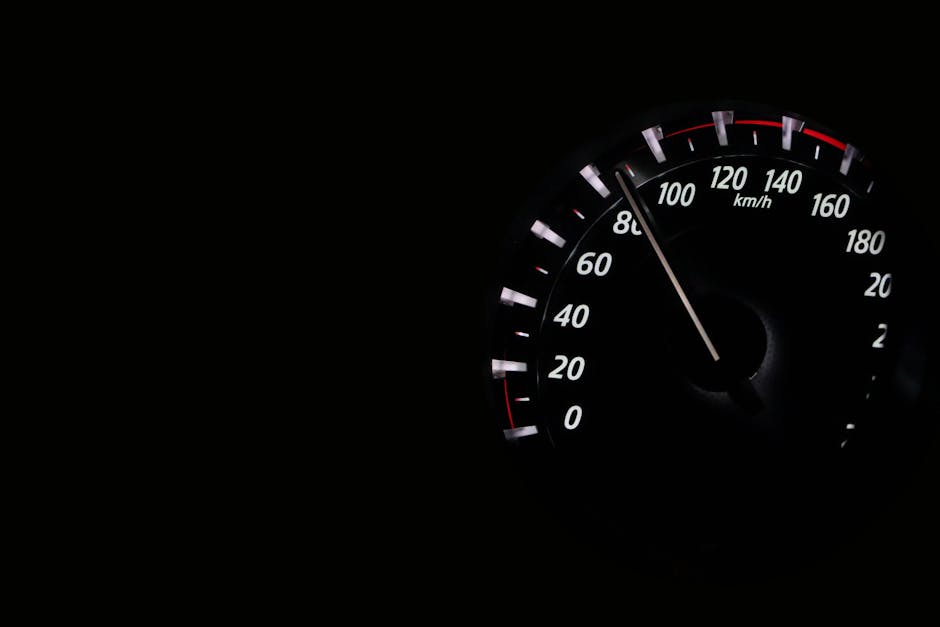
Photo by Pixabay on Pexels
- Speed is how fast an object is moving, regardless of direction. It's a scalar.
- Average Speed = Total Distance / Total Time
- Velocity is how fast an object is moving and in what direction. It's a vector.
- Average Velocity ($\vec{v}_{avg}$) = Displacement ($\Delta x$) / Time Interval ($\Delta t$)
- Instantaneous Velocity is the velocity at a specific moment in time.
Acceleration
- Acceleration is the rate at which an object's velocity changes. It's a vector. An object accelerates if it speeds up, slows down, or changes direction.
- Average Acceleration ($\vec{a}_{avg}$) = Change in Velocity ($\Delta \vec{v}$) / Time Interval ($\Delta t$)
- $\Delta \vec{v}$ = Final Velocity ($\vec{v}_f$) - Initial Velocity ($\vec{v}_i$)
- Instantaneous Acceleration is the acceleration at a specific moment in time.
If an object has constant velocity, its acceleration is zero. If its velocity is changing, it's accelerating.
Here's how these concepts are related:
graph TD
    A["Position (x)"] --> B["Displacement (Δx)"];
    A --> C["Distance"];
    B --> D["Average Velocity (Δx/Δt)"];
    B --> E["Instantaneous Velocity (dx/dt)"];
    C --> F["Average Speed (Distance/Δt)"];
    D --> G["Average Acceleration (Δv/Δt)"];
    E --> G;
    E --> H["Instantaneous Acceleration (dv/dt)"];
Kinematic Equations for Constant Acceleration

Photo by Monstera Production on Pexels
When acceleration is constant (a very common and useful simplification!), we have a set of equations that relate position, velocity, acceleration, and time. These are your bread and butter for solving many kinematics problems.
- $v = v_0 + at$
(This tells you your final velocity after a time $t$, given your initial velocity $v_0$ and constant acceleration $a$.) - $\Delta x = v_0 t + \frac{1}{2} at^2$
(This helps you find your displacement given initial velocity, acceleration, and time.) - $v^2 = v_0^2 + 2a \Delta x$
(Use this one if you don't know the time or don't need to find it.) - $\Delta x = \frac{1}{2} (v_0 + v) t$
(Another way to find displacement, useful if you know both initial and final velocities.)
Here, $v_0$ is the initial velocity, $v$ is the final velocity, $a$ is the constant acceleration, $t$ is the time interval, and $\Delta x$ is the displacement. Remember that direction matters for vectors, so "negative" can mean "opposite direction."
3. Worked Example
A car starts from rest (meaning $v_0 = 0$) and accelerates uniformly at $2.0 \text{ m/s}^2$ for $5.0 \text{ s}$. How far did it travel in this time?
- Identify what you know:
- Initial velocity ($v_0$) = $0 \text{ m/s}$ (starts from rest)
- Acceleration ($a$) = $2.0 \text{ m/s}^2$
- Time ($t$) = $5.0 \text{ s}$
- Identify what you want to find:
- Displacement ($\Delta x$)
- Choose the right kinematic equation:
- Looking at our equations, $\Delta x = v_0 t + \frac{1}{2} at^2$ has all the variables we know and the one we want to find.
- Plug in the values and solve:
- $\Delta x = (0 \text{ m/s})(5.0 \text{ s}) + \frac{1}{2} (2.0 \text{ m/s}^2)(5.0 \text{ s})^2$
- $\Delta x = 0 + \frac{1}{2} (2.0)(25)$
- $\Delta x = 0 + (1.0)(25)$
- $\Delta x = 25 \text{ m}$
The car traveled 25 meters.
4. Key Takeaways
- Kinematics describes how objects move (position, velocity, acceleration), not why.
- Position, displacement, velocity, and acceleration are all vectors, meaning they have both magnitude and direction.
- Distance and speed are scalars, meaning they only have magnitude.
- Acceleration is the rate of change of velocity, not just speed.
- The four kinematic equations are powerful tools for problems involving constant acceleration.
- Always define a positive direction and stick to it throughout your calculations.
Common Mistakes to Avoid

Photo by KATRIN BOLOVTSOVA on Pexels
- Confusing distance with displacement, or speed with velocity. Remember, vectors have direction!
- Using the kinematic equations when acceleration isn't constant. They only work for uniform acceleration.
- Forgetting to include units in your answer, or using inconsistent units.
- Mixing up $v$ (final velocity) and $v_0$ (initial velocity) in the equations.
5. Now Try It
A bicycle traveling at $10 \text{ m/s}$ applies its brakes and accelerates uniformly at $-2.0 \text{ m/s}^2$ until it stops. Calculate the distance the bicycle travels while braking. You should be able to identify starting conditions, choose the right formula, and get a positive distance value as your answer.
Frequently asked about Kinematics: Describing Motion
Study this next
Get the full fisicaa gay curriculum
Clone the complete plan to your dashboard for unlimited AI-generated notes, practice quizzes, and a personalised revision schedule.
Save this course free