How to Study Mathematics: Why Reading Your Textbook is Causing You to Fail
By Ian Waiguru, founder of StudyAI · · 3 min read
If you have ever stared at a math exam question and thought, "I understood this in class, why can't I solve it now?"—you are not alone.
Mathematics is the most misunderstood subject in school. Most students try to study Math the same way they study History or English: they read their notes.
As a Civil Engineer, I can tell you this: Reading math is a waste of time. It is like watching videos of someone doing pushups and expecting your own muscles to grow. Math is not knowledge; it is a skill. The only way to learn it is to do it.
Here is the 3-step framework to actually master a new math concept, stop blanking out during exams, and cut your revision time in half.
1. The "Spectator Sport" Fallacy
The biggest mistake students make is "Passive Review." You open your textbook, look at an example problem, nod your head, and say, "Yeah, I get that step."
Your brain is lying to you. Recognizing a step is easy; generating the next step yourself is hard.
The Fix: Never read a math solution without a pen in your hand. Cover the solution with a piece of paper. Try to solve it. Only look when you are truly stuck. If you had to look, you didn't learn it. Mark it and try again tomorrow.
2. The "Unlimited Problem" Strategy
The second biggest problem is running out of practice material. Your textbook might have 5 good questions on "Integration by Parts." Once you finish those, what do you do?
In the past, you had to scour the internet for "past papers" or ask your teacher for extra worksheets. Today, you can use AI to generate infinite practice problems tailored exactly to your syllabus.
I built StudyAI specifically to solve this "content drought." You can upload a single PDF of your lecture notes, and the AI will analyze the logic and generate fresh practice questions for you.
Here is what it looks like when I upload my Calculus notes:
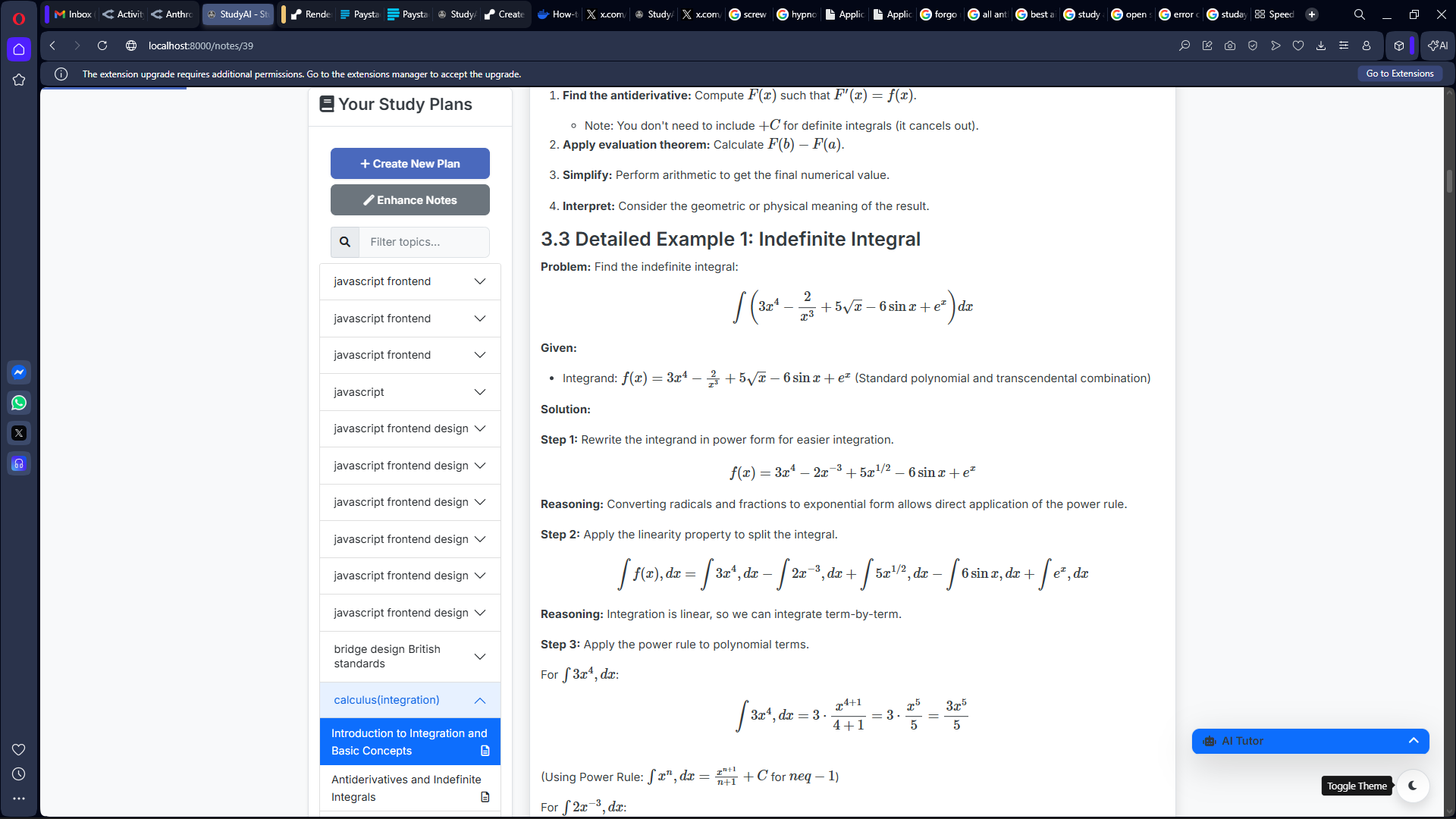 (Caption: StudyAI analyzing a Calculus PDF and generating a structured summary)
3. Don't Just Solve—Find the "Pitfalls"
In engineering, a small calculation error can make a bridge collapse. In an exam, a dropped negative sign can cost you 10 marks.
Most students focus on the method but ignore the mechanics. You need to identify your specific "Exam Pitfalls"—the tiny mistakes you make repeatedly.
When you generate notes with StudyAI, it doesn't just summarize the topic; it creates a specific section called "Exam Pitfalls" to warn you about common traps.
Check out how it breaks down this topic:
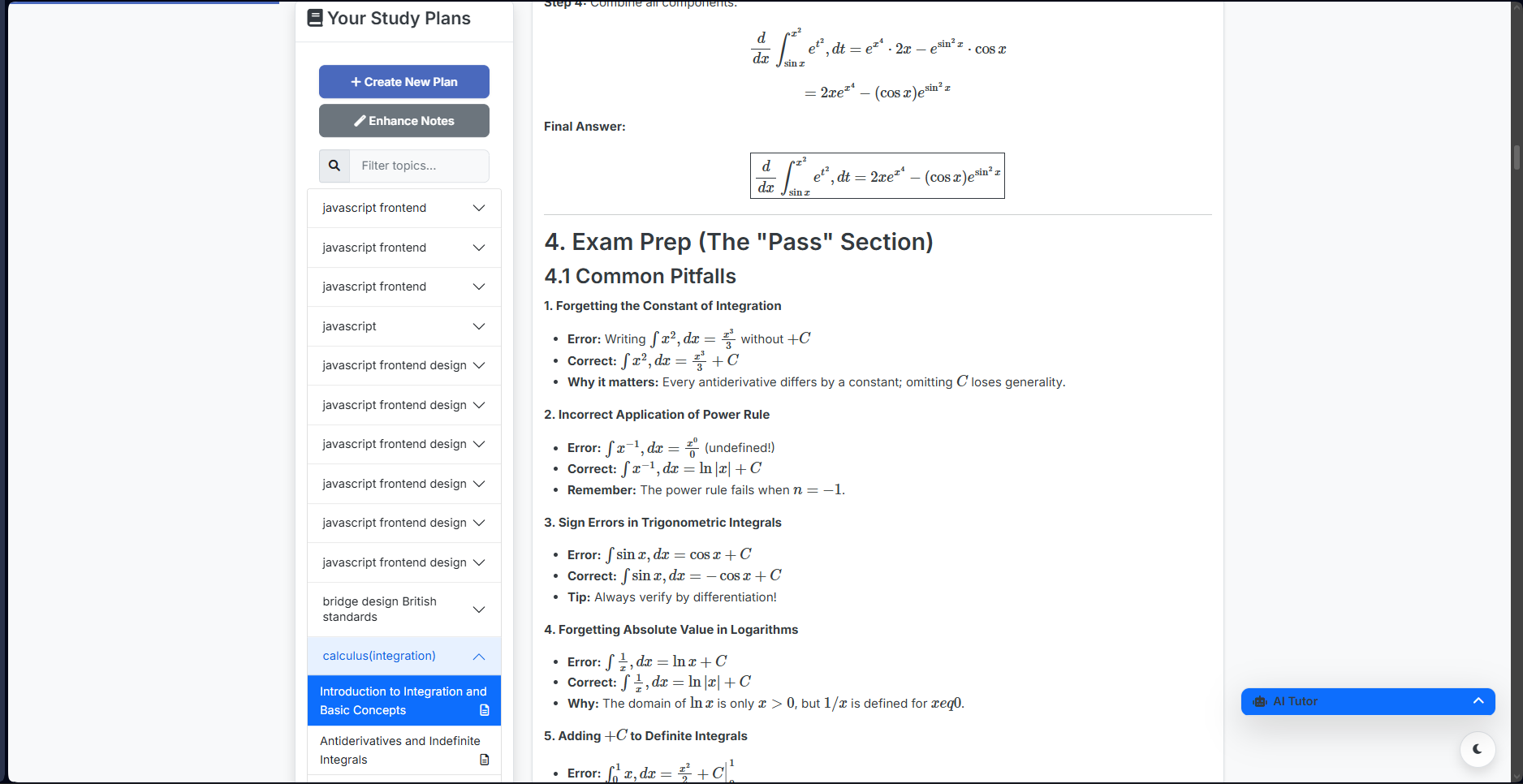 (Caption: The AI automatically flagging common mistakes so you don't make them on the final)
4. The 80/20 Rule for Math
You don't need to memorize every theorem. You need to master the 20% of concepts that show up on 80% of the exam.
Instead of re-reading 200 pages of a textbook, use an AI summarizer to extract the High-Yield Concepts. 1. Upload your chapter PDF. 2. Generate a summary to get the core formulas. 3. Quiz yourself immediately.
Conclusion: Stop Reading, Start Solving
If you have a math exam coming up, put the textbook away.
- Get Your Material: Upload your class notes to StudyAI OR simply enter your course name (e.g., "SAT Maths," "Calculus 1," "Differential Equations"). The AI works perfectly even without uploading files.
- Get the Blueprint: Let the AI generate a detailed summary complete with calculation examples, visual charts, and specific "Exam Pitfalls."
- Clarify the Hard Stuff: Stuck on a concept? Ask the AI Tutor specific questions about the generated notes to clear up confusion instantly.
- Test Yourself: Generate a practice quiz and keep testing yourself until you can solve the problems without peeking.
Math isn't magic. It's just practice.
Stop reading about studying. Start actually learning.
StudyAI turns your syllabus into a revision timetable, notes with diagrams and practice quizzes, free to start.
Make my study plan free